Integrating Molecular Docking, Molecular Dynamics Simulations, and Binding Free Energy Calculations in Modern Drug Discovery
Keywords:
- Molecular docking; molecular dynamics; binding free energy; MM-PBSA; MM-GBSA; free energy perturbation; structure-based drug design; virtual screening; AlphaFold
Abstract
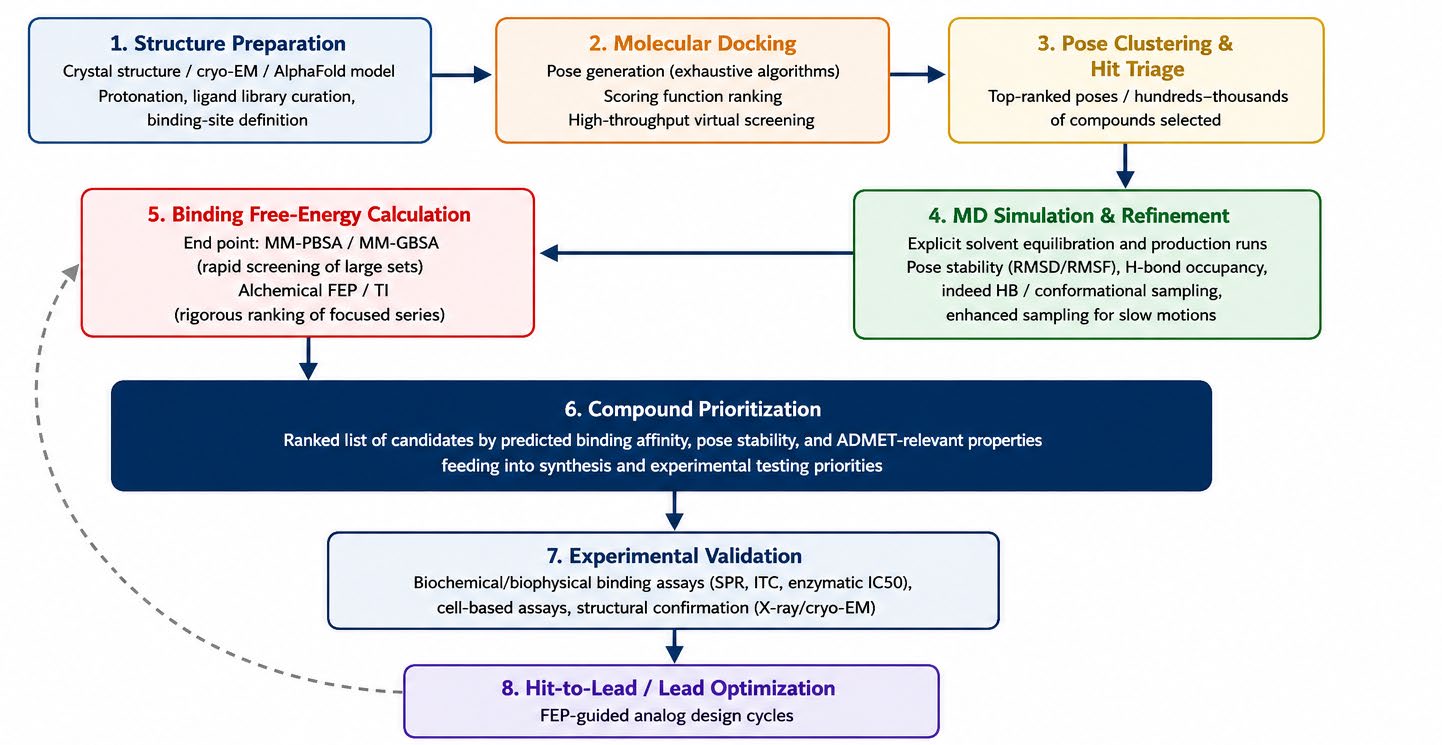
Background: Structure-based computational methods have become indispensable in modern drug discovery, enabling rational identification and optimization of small-molecule therapeutics before costly experimental synthesis and testing. Molecular docking, molecular dynamics (MD) simulations, and binding free energy calculations each address distinct aspects of the protein–ligand recognition problem, and their integration into unified computational pipelines has become standard practice in both academic and industrial drug discovery. Objective: This review synthesizes the principles, capabilities, and limitations of molecular docking, MD simulations, and binding free energy methods, including end-point approaches (MM-PBSA/MM-GBSA) and alchemical approaches (free energy perturbation [FEP], thermodynamic integration [TI]) and describes how their integration into a staged workflow improves the accuracy and efficiency of hit identification and lead optimization, while critically examining the accuracy-versus-cost trade-offs that govern method selection at each stage. Methods: A narrative literature synthesis was conducted using PubMed, Scopus, and Google Scholar (inception–June 2026), focusing on methodological reviews, benchmark studies, and representative case studies describing docking, MD, and binding free energy methods and their integrated application in drug discovery, as detailed in Section 2. Results: Docking provides rapid, moderate-accuracy pose and rank predictions suitable for large-scale virtual screening but is limited by rigid or semi-flexible treatment of the receptor and approximate scoring functions. MD simulations refine docking-derived poses by incorporating explicit solvent, full protein and ligand flexibility, and time-dependent sampling, but do not themselves yield quantitative binding affinities. End-point free energy methods (MM-PBSA/MM-GBSA) offer a favorable accuracy-to-cost ratio for rank-ordering moderate-sized compound sets, while alchemical methods (FEP/TI), most notably exemplified by Schrödinger's FEP+ platform, can achieve accuracy approaching 1 kcal/mol relative to experiment for congeneric series, at substantially higher computational cost, and are correspondingly reserved for focused lead-optimization campaigns. Deep-learning approaches, including AlphaFold2/3-class structure prediction and machine-learning scoring functions, are increasingly integrated into these pipelines but currently show mixed generalizability for novel chemotypes. Conclusion: No single computational method is sufficient across the full drug discovery pipeline; rational integration of docking, MD, and tiered free energy calculations, increasingly complemented by machine learning, provides a pragmatic, accuracy-appropriate strategy for each stage from hit identification through lead optimization. Continued benchmarking, standardization, and cautious interpretation of machine-learning-derived predictions remain priorities for the field.
Downloads
References