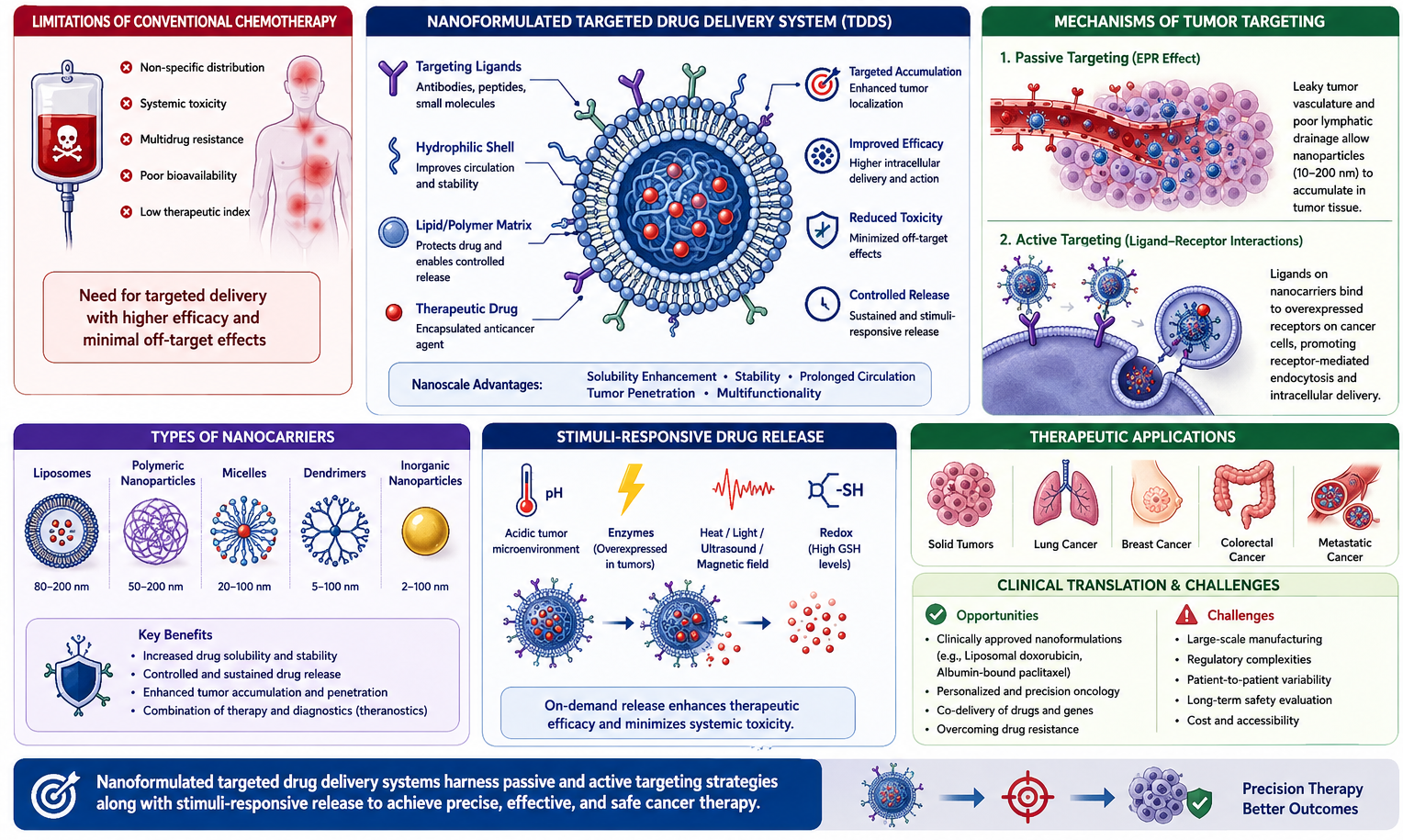
Advanced Nanoformulations in Targeted Drug Delivery Systems for Precision Cancer Therapy: Mechanisms, Therapeutic Applications, and Clinical Translation
Keywords:
- Cancer therapy, Targeted drug delivery system (TDDS), Nanotechnology, Liposomes, Nanocarriers, Enhanced permeability and retention (EPR) effect, Active targeting, Stimuli-responsive nanoparticles, Precision medicine.
Abstract
Cancer remains a predominant cause of global death, with traditional chemotherapy frequently exhibiting shortcomings including systemic toxicity, multidrug resistance, and a suboptimal therapeutic index. Nanoformulated targeted drug delivery systems (TDDS) have emerged as a potential method in cancer to tackle these problems. Utilising the enhanced permeability and retention (EPR) effect, in conjunction with active targeting mechanisms such ligand-receptor interactions, nanocarriers provide increased site-specific drug accumulation and less off-target effects. Clinically validated formulations, such as liposomal doxorubicin and albumin-bound paclitaxel, confirm the translational potential of nanotechnology in improving cancer treatment. Moreover, stimuli-responsive nanocarriers and multifunctional platforms provide regulated release, co-delivery of several therapeutic drugs, and synergistic effects, thereby surmounting obstacles presented by the tumour microenvironment. Nonetheless, despite these advancements, obstacles such as large-scale manufacturing, regulatory intricacies, and heterogeneous patient-specific responses persist in hindering widespread clinical use.This study elucidates the design, methods, benefits, and obstacles of nanoformulated transdermal drug delivery systems (TDDS) in cancer treatment, underscoring its significance in advancing precision and personalised oncology.
Downloads
References