Phyllanthus niruri in Non-Alcoholic Fatty Liver Disease (NAFLD): Phytochemical Profiling, Metabolomic Insights, and Multi-Target Hepatoprotective Mechanisms
Keywords:
- Non-alcoholic fatty liver disease, Phyllanthus niruri, L, Antioxidant and Anti-inflammatory
Abstract
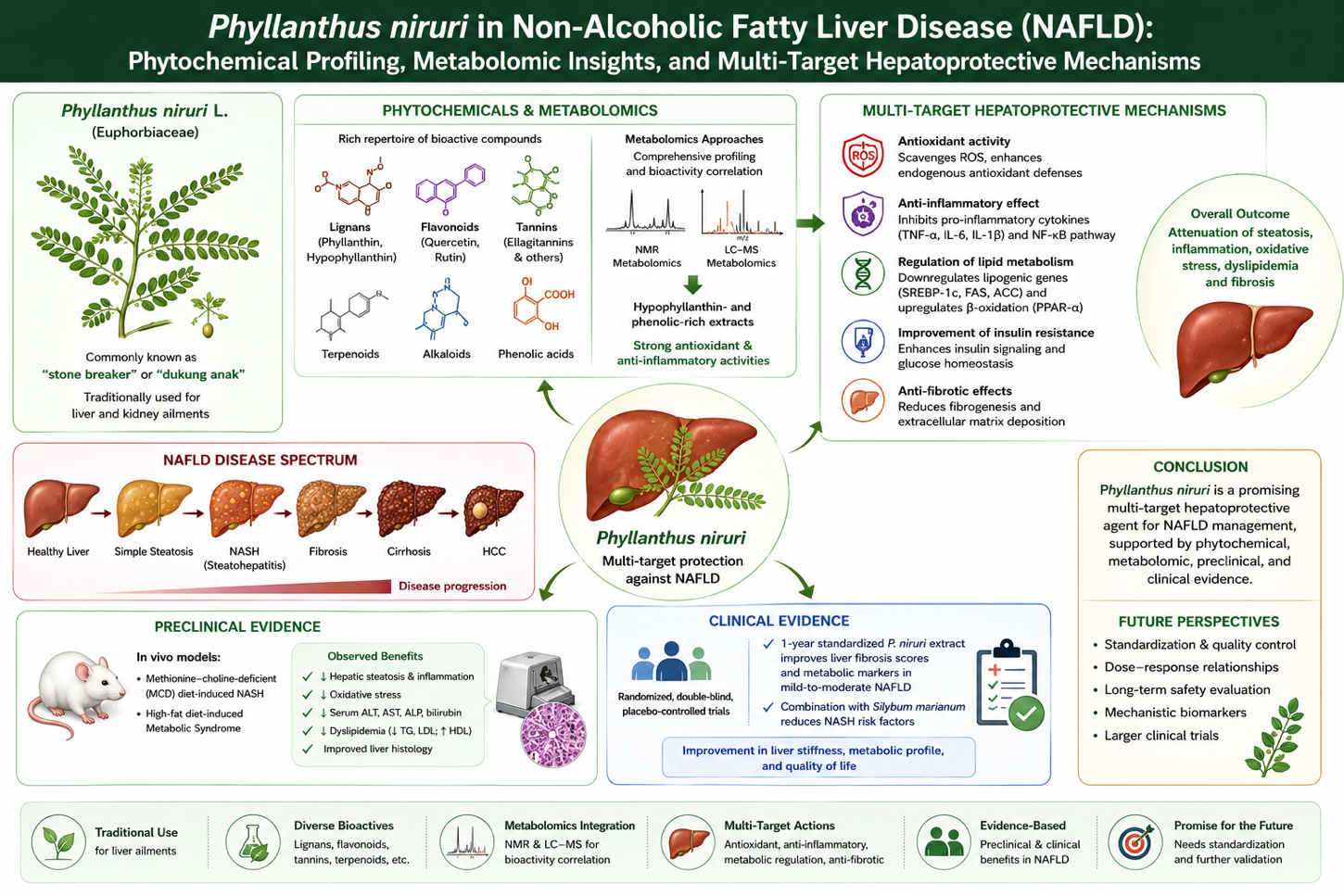
Non-alcoholic fatty liver disease (NAFLD) is the hepatic manifestation of metabolic syndrome and encompasses a spectrum from simple steatosis to non-alcoholic steatohepatitis (NASH), fibrosis, cirrhosis, and hepatocellular carcinoma. Given the limited pharmacotherapy options and growing prevalence, interest has grown in hepatoprotective botanicals with multi-target mechanisms. Phyllanthus niruri L. (Euphorbiaceae), commonly known as “stone breaker” or “dukung anak”, is widely used in traditional systems for liver and kidney ailments and has demonstrated hepatoprotective, antioxidant, anti-inflammatory, antiviral, and metabolic effects. This review synthesizes current evidence on phytochemical profiling and bioactivity of P. niruri in NAFLD, emphasizing metabolomics and biochemical analyses. Phytochemical studies reveal a rich repertoire of lignans (phyllanthin, hypophyllanthin), flavonoids (quercetin, rutin), ellagitannins and other tannins, terpenoids, alkaloids, and phenolic acids, whose relative abundance depends on plant part, geographical origin, and extraction conditions. Nuclear magnetic resonance (NMR)- and LC–MS-based metabolomics enable comprehensive profiling of primary and secondary metabolites and their correlation with bioactivity, as exemplified by studies linking hypophyllanthin- and phenolic-rich extracts to strong antioxidant and anti-inflammatory activities. In vivo, standardized P. niruri extracts attenuate steatosis, inflammation, oxidative stress, and dyslipidemia in NAFLD models, including methionine–choline-deficient (MCD) diet-induced steatohepatitis and high-fat-diet-induced MetS models, with improvements in serum transaminases, bilirubin, lipid profile, and hepatic histology. Mechanistic work implicates modulation of oxidative stress pathways, inhibition of inflammatory mediators, regulation of lipid metabolism genes, and attenuation of insulin resistance. Recent randomized, double-blind, placebo-controlled clinical trials indicate that one-year supplementation with standardized P. niruri extract improves liver fibrosis scores and metabolic markers in patients with mild-to-moderate NAFLD and reduces NASH risk factors when combined with Silybum marianum in a fixed-dose formulation. This article integrates phytochemical, metabolomic, and biochemical data to provide a comprehensive picture of P. niruri as a promising multi-target agent for NAFLD management, while highlighting gaps related to standardization, dose–response relationships, long-term safety, and mechanistic biomarkers
Downloads
References