Network Pharmacology and Artificial Intelligence in Natural Product-Based Drug Discovery: Opportunities and Challenges
Keywords:
- Pharmacology; Artificial Intelligence; Machine Learning; Natural Products; Drug Discovery; Polypharmacology; Generative AI; Alphafold
Abstract
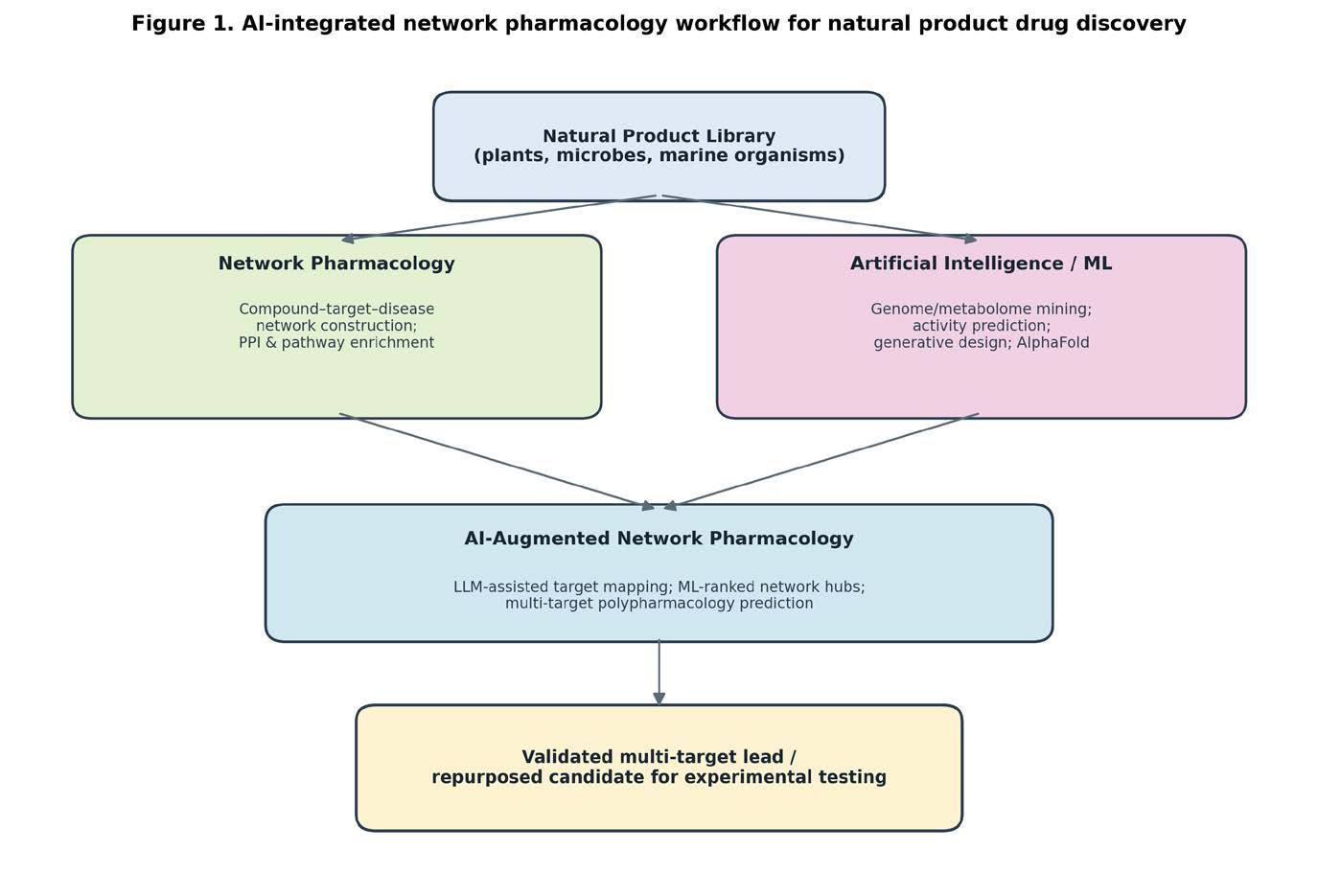
Natural products remain one of the most productive sources of clinically approved drugs, yet their inherent structural complexity and characteristic polypharmacology have historically made them difficult to study within the reductionist “one drug, one target” framework that has dominated modern pharmaceutical research. Network pharmacology, formalised as a distinct discipline in 2008, reframes drug action as a perturbation of interconnected biological networks rather than a single receptor-ligand interaction, providing a natural conceptual and computational home for multi-component, multi-target natural products and traditional herbal formulations. Over the past decade, this systems-level framework has converged with rapid advances in artificial intelligence (AI) and machine learning (ML) including genome and metabolome mining, graph neural networks for bioactivity prediction, generative molecular design, and highly accurate protein structure prediction to create an integrated computational pipeline capable of prioritising natural compounds, predicting their multi-target mechanisms, and generating novel natural-product-inspired chemical matter at a scale and speed previously unattainable. This review describes the principles and standard workflow of network pharmacology, surveys the major classes of AI methods now applied across the natural product drug discovery pipeline, and presents representative case studies in which AI-augmented network pharmacology has produced experimentally validated or clinically advanced leads. We then critically examine the opportunities this convergence creates faster hypothesis generation, systematic exploration of polypharmacology, and reduced reliance on exhaustive wet-laboratory screening alongside the methodological challenges that currently limit its reliability, including inconsistent database annotation, small and imbalanced training datasets, limited experimental validation of computational predictions, poor reproducibility of network construction choices, and the interpretability limitations of many deep learning models. We conclude with priority recommendations for standardising network pharmacology methodology and for integrating AI predictions with experimental validation pipelines, in order to translate the considerable current computational promise of this field into reproducible, clinically meaningful natural product drug discovery.
Downloads
References